
Attachment - A* Model Essays
This document contains model answers for every 16-mark essay question that may appear in Attachment. Each answer has been verified using specialist AI marking software and awarded between 14 and 16 marks, with the rationale for each mark documented in the comments section.
Colour-coded annotations follow a consistent system throughout:
Black — AO1 (Knowledge and Understanding)
Red — AO3 (Evaluation: Counterargument)
Orange — AO3 (Evaluation: Interactionist perspective)
Green — AO3 (Evaluation: Supporting argument)
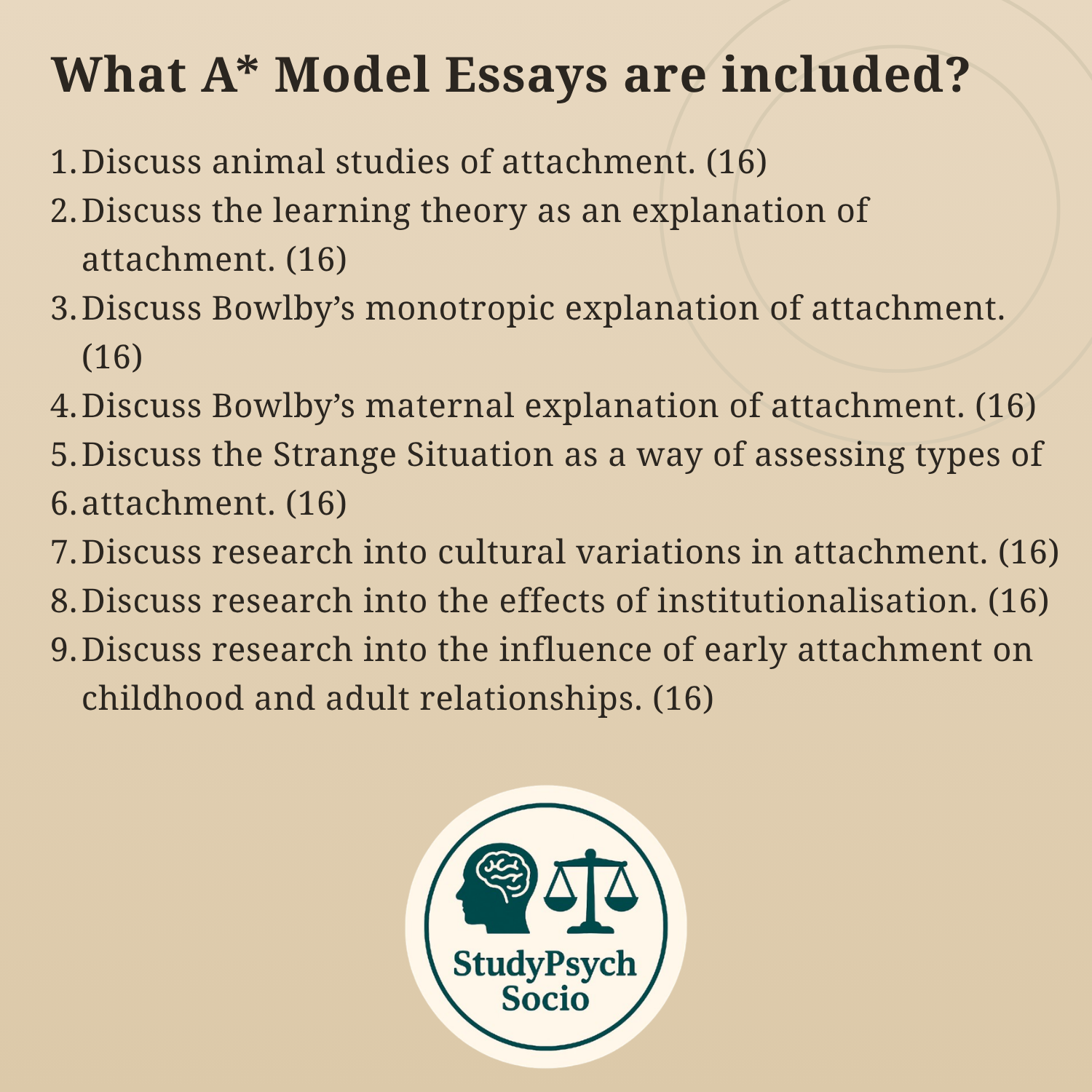
What A* Model Answers are included:
Discuss animal studies of attachment. (16)
Discuss the learning theory as an explanation of attachment. (16)
Discuss Bowlby’s monotropic explanation of attachment. (16)
Discuss Bowlby’s maternal explanation of attachment. (16)
Discuss the Strange Situation as a way of assessing types of
attachment. (16)
Discuss research into cultural variations in attachment. (16)
Discuss research into the effects of institutionalisation. (16)
Discuss research into the influence of early attachment on childhood and adult relationships. (16)
Attachment - A* Model Essays
This document contains model answers for every 16-mark essay question that may appear in Attachment. Each answer has been verified using specialist AI marking software and awarded between 14 and 16 marks, with the rationale for each mark documented in the comments section.
Colour-coded annotations follow a consistent system throughout:
Black — AO1 (Knowledge and Understanding)
Red — AO3 (Evaluation: Counterargument)
Orange — AO3 (Evaluation: Interactionist perspective)
Green — AO3 (Evaluation: Supporting argument)
What A* Model Answers are included:
Discuss animal studies of attachment. (16)
Discuss the learning theory as an explanation of attachment. (16)
Discuss Bowlby’s monotropic explanation of attachment. (16)
Discuss Bowlby’s maternal explanation of attachment. (16)
Discuss the Strange Situation as a way of assessing types of
attachment. (16)
Discuss research into cultural variations in attachment. (16)
Discuss research into the effects of institutionalisation. (16)
Discuss research into the influence of early attachment on childhood and adult relationships. (16)